
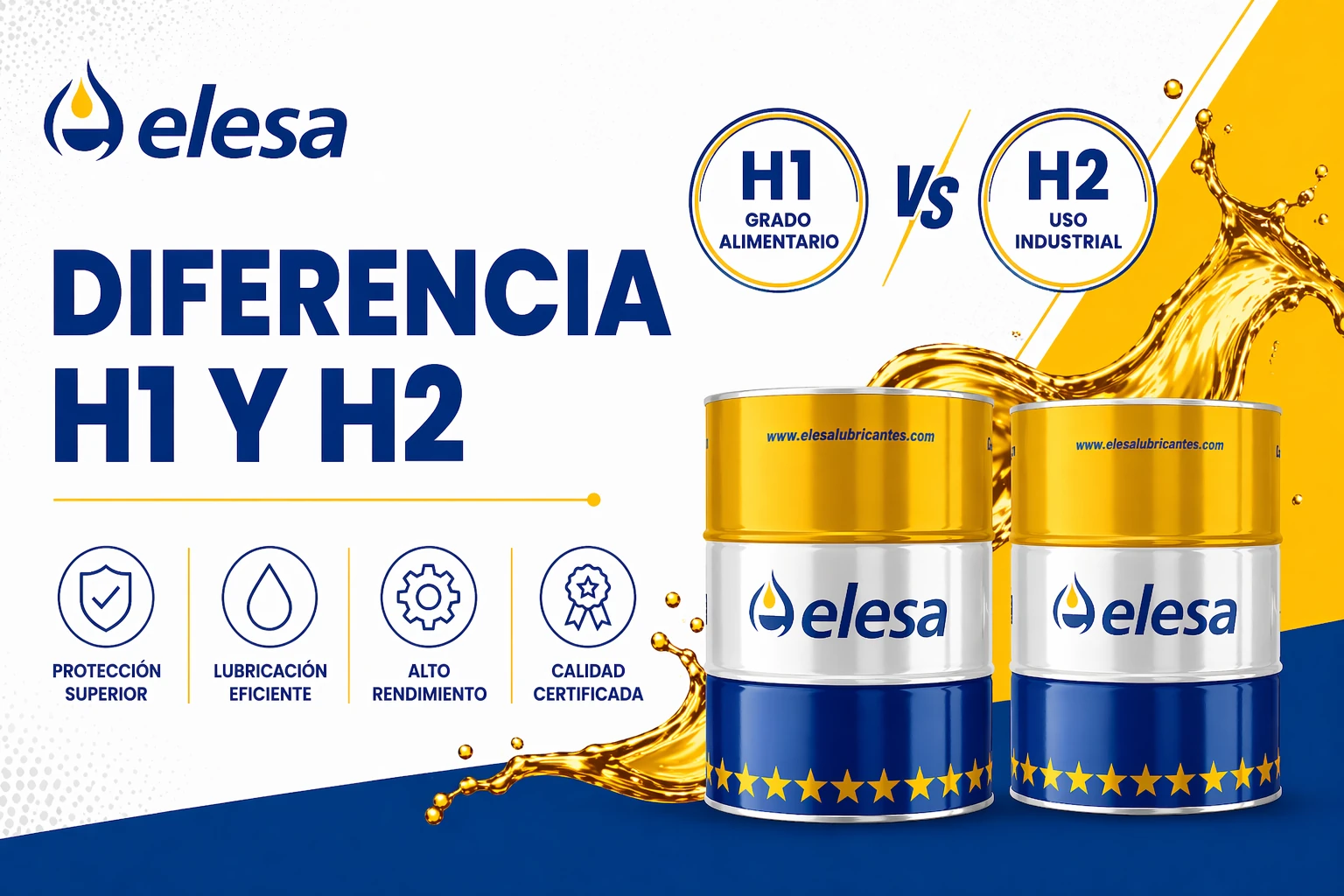
In the food industry, choosing the right lubricant affects not only machinery performance but also the safety of the final product and regulatory compliance. In this context, H1 and H2 lubricants are two categories defined by NSF that raise many questions, particularly regarding their use and how they differ. Understanding what sets an H1 lubricant apart from an H2 is essential to avoid contamination risks, pass audits and ensure safe production in environments where contact with food is a critical factor.
What are H1 lubricants
H1 lubricants are designed for use in the food industry in applications where incidental contact with food is possible. This means that, in the event of accidental contact, the lubricant does not pose a health risk as long as it stays within the established limits.
These products are formulated with approved ingredients and meet strict safety requirements, making them the mandatory choice for most food production, processing and packaging equipment. They are commonly used on production lines, conveyors, bearings and machinery where there is a risk of contact, even if unintentional.
What are H2 lubricants
H2 lubricants, for their part, are intended for industrial applications where there is no possibility whatsoever of contact with food. Unlike H1 lubricants, these products are not formulated to the same food safety requirements, so their use is restricted to areas away from the production process.
These lubricants can offer good technical performance, but they must not be used in environments where there is a risk of contamination, as they do not meet the regulations required to guarantee food safety.
Key differences between H1 and H2
The main difference between H1 and H2 lubricants lies in their level of safety in the event of contact with food. While H1 lubricants are formulated to minimise risks in the event of incidental contact, H2 lubricants are not approved for such situations.
In addition, H1 lubricants must meet specific composition and certification requirements, which ensures they can be used safely in the food industry. H2 lubricants, on the other hand, are not subject to these restrictions, which limits their use to environments where there is no contact with food.
Choosing one or the other does not depend solely on technical criteria, but mainly on the application environment and the regulations that must be complied with.
When to use H1 or H2 lubricants
In the food industry, the general recommendation is to use H1 lubricants whenever there is even the slightest possibility of contact with food, as this ensures regulatory compliance and reduces risks.
H2 lubricants should only be used in areas completely isolated from the production process, such as technical areas or auxiliary equipment where there is no direct or indirect contact with food.
In practice, many companies choose to standardise on H1 lubricants across the entire plant to simplify management and avoid mistakes that could compromise food safety.
Risks of using the wrong lubricant
Using the wrong lubricant in the food industry can have serious consequences, both for health and financially. Product contamination is the main risk, which can lead to product recalls, penalties and reputational damage.
In addition, non-compliance with regulations can affect quality audits and certifications, jeopardising business continuity. That is why it is essential to select the right type of lubricant for each application.
Ensure food safety with the right lubricant
Understanding the difference between H1 and H2 lubricants is key to ensuring proper lubrication management in the food industry. Choosing the right product not only protects machinery but also guarantees the safety of the final product and compliance with current regulations.
Choosing certified lubricants designed for these environments is a strategic decision that improves efficiency, reduces risks and provides peace of mind in demanding production processes.