
PTFE (Polytetrafluoroethylene)
How was PTFE discovered?
As in so many other cases in industry, PTFE was discovered by accident. In 1938, Roy Plunkett, a chemist at the legendary firm Du PONT, was searching for new compounds when he accidentally came across one with excellent mechanical properties and behaviour: that product was polytetrafluoroethylene (PTFE), popularly known as TEFLON. It was not until 1946 that it began to be marketed, in all kinds of configurations and formats: parts, sheets, tapes, fabrics or, in the case of lubricants, very fine powder.
What is PTFE?
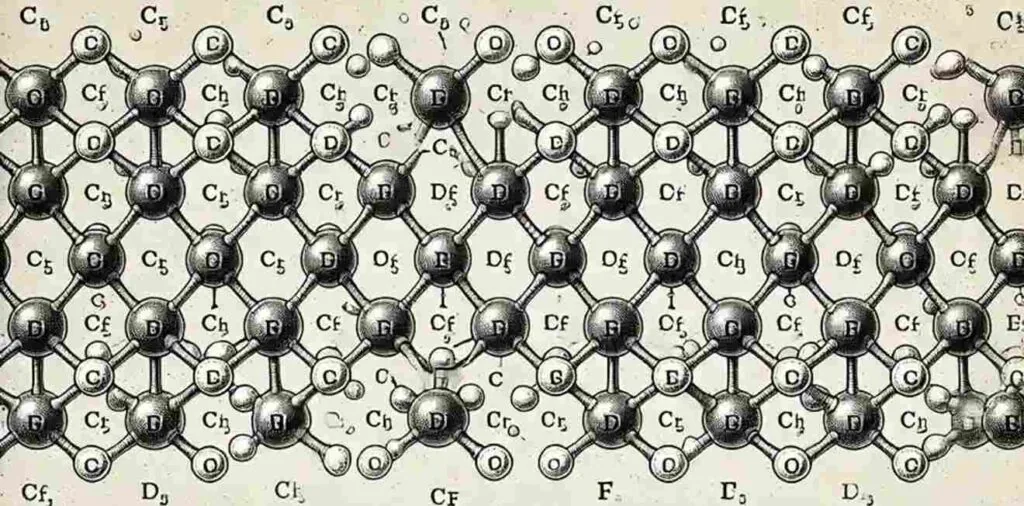
Teflon (PTFE) is a fluorinated polymer distinguished by its unique molecular structure, made up of carbon-fluorine bonds, which are among the strongest in organic chemistry. This configuration gives it exceptional properties, such as:
- Chemical stability: Resistant to virtually all known chemicals.
- Thermal stability: Retains its properties from -200°C to 260°C.
- Low coefficient of friction: Due to its chemical structure, sliding intermolecular interactions occur on its surface, making it ideal for applications as a solid lubricant and non-stick agent.
- High resistance to fire and high temperatures.
- Corrosion resistance: Immune to strong acids and bases, ideal for chemical applications.
- Superior electrical properties: High dielectric strength, suitable for high-frequency and high-voltage applications.
- Low-temperature flexibility: Retains its flexibility and strength at extremely low temperatures, benefiting applications in cold environments.
PTFE IN LUBRICANTS
Given the mechanical properties of PTFE, it began to be marketed in industrial lubricants and greases back in the '70s. It is used as a component in lubricating oils mainly in the form of a very fine powder, homogeneously dispersed in the lubricant, and its main – but not only – role is to separate surfaces that may come into contact and lower the coefficient of friction.
The technical explanation:
As a solid-type additive, it prevents the metal surfaces of a moving mechanism from coming into contact, avoiding micro-welding and surface deformation of the mechanisms, generally caused by the breakdown of the lubricating film (boundary lubrication) at critical operating points of the mechanism. The shape of its particles gives the lubricant a low coefficient of friction. Visually, it can be pictured as “running over a field of wet leaves and braking sharply.”
Other properties PTFE gives to lubricating oil or grease:
- Resistance to extreme temperatures: Works effectively across a temperature range of -200 °C to 260 °C without compromising its properties.
- Chemically inert: PTFE does not react with most chemicals, making it a safe choice in aggressive industrial environments.
- Non-stick: Its surface does not stick to other materials, making cleaning easier and preventing residue build-up.
- High corrosion resistance: Protects metal surfaces against oxidation and wear.
PTFE in ELESA products:
Using PTFE lubricants brings critical advantages to industrial machinery:
- Less wear: PTFE forms a protective layer on surfaces, reducing direct contact between parts and minimising friction.
- Greater efficiency: By reducing friction, PTFE lubricants help improve the energy efficiency of systems.
- Longer equipment life: Products formulated with PTFE offer excellent resistance to wear and corrosion, which extends component life.
- Excellent performance in severe conditions: Whether at extreme temperatures or in contact with chemicals, PTFE lubricants continue to perform optimally.
Careful formulation with this additive can give your lubricant and/or grease exceptional lubricating properties. At Elesa, we offer a range of high-quality products formulated with PTFE to ensure superior performance in a variety of industrial applications. Here are some of our featured products:
In aerosols:
- LUBRITEF H-1 AEROSOL: a multipurpose spray lubricating oil with a high E.P. additive content and friction modifiers such as PTFE, which safeguards and protects machinery even when lubrication is insufficient. H-1
- ARIS TF AEROSOL: a multipurpose spray lubricating grease with a high E.P. additive content and friction modifiers such as PTFE, which safeguards and protects machinery even when lubrication is insufficient.
- NT H1 TF AEROSOL: a highly adhesive non-toxic spray grease (with PTFE), specially developed for packaging machinery.
- H1 CERÁMICA TF AEROSOL: a ceramic-based anti-seize paste for lubrication and assembly, with a fully synthetic base, for long-lasting lubrication in difficult environmental conditions. Suitable for points with incidental food contact.
In oils:
- AIR H1 TF SERIE Semi-synthetic medicinal-grade oil, developed to meet all the needs of sectors where incidental contact with the product may occur. Multifunctional use, with anti-wear additives and friction modifiers.
- CHAIN H1 1500 TF is an oil designed to lubricate chain systems that carry high loads and are subjected to frequent washing with pressurised water jets. Specially formulated from medicinal-grade paraffinic base oils, synthetic oils and viscosity-modifying additives. The oil does not drip off the chain.
- AIR SN TF are mineral-based oils for pneumatic systems, with PTFE additives that ensure the correct operation and protection of compressed-air-driven machinery.
- Gear Ind Plus TF: An ideal lubricant for industrial gears operating under high loads. Thanks to its PTFE content, it offers excellent wear protection, extending equipment service life. It is perfect for high-friction environments and extreme temperatures.
In greases:
- ARIS TF: Multipurpose lubricating grease with a high E.P. additive content and Teflon, which safeguards and protects machinery even when lubrication is insufficient.
- Pasta H1 Silicona TF: Formulated with PTFE, this paste is ideal for food applications requiring a food-grade (H1) lubricant that works at extreme temperatures. As well as being resistant to oxidation and wear, it provides effective, long-lasting lubrication.
- Grasa Sint 090 TF: A high-performance synthetic grease reinforced with PTFE, specially designed for equipment operating under high pressure and severe temperatures. Its formulation ensures excellent resistance to oxidation and corrosion, providing long-lasting lubrication.
- SILICONA H1 TF: a silicone fluid grease with Teflon and a synthetic thickener. Highly resistant to mechanical working.
- ALPLEX U1 002 TF SERIES is a range of mineral-based lubricating greases thickened with aluminium complex and fortified with solid PTFE-type (Teflon) EP additives to improve their performance. Its rheological structure makes this grease especially suitable for centralised lubrication systems.
- 090 EP/TF 2 is a high-performance synthetic lubricating grease with no dropping point, formulated with Teflon (PTFE).
Today, in response to growing awareness of the harmful effects of microplastics on the planet, the elimination and banning of these plastic fragments is being encouraged in various products – though not yet in lubricants. At ELESA we can advise you on managing waste lubricant and lubricant containing Teflon.
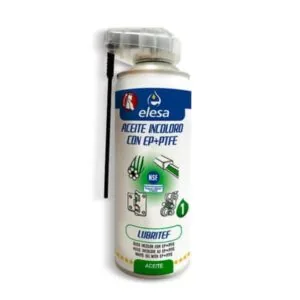
LUBRITEF
VIEW PRODUCTS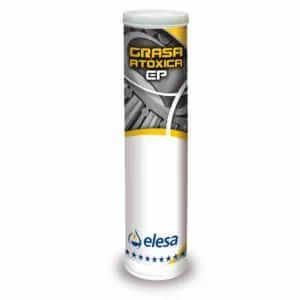
SILICONA H1 TF
VIEW PRODUCTS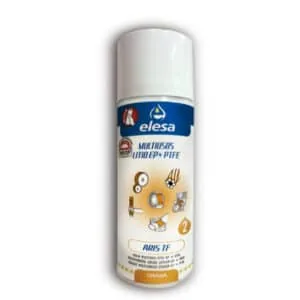
ARIS TF
VIEW PRODUCTS Contact- CR CHINCHON PUENTE DE ARGANDA A CHINCHON KM 2 28500, ARGANDA DEL REY (MADRID)
- +34 918 719 360
- info [at] elesalubricantes.com