
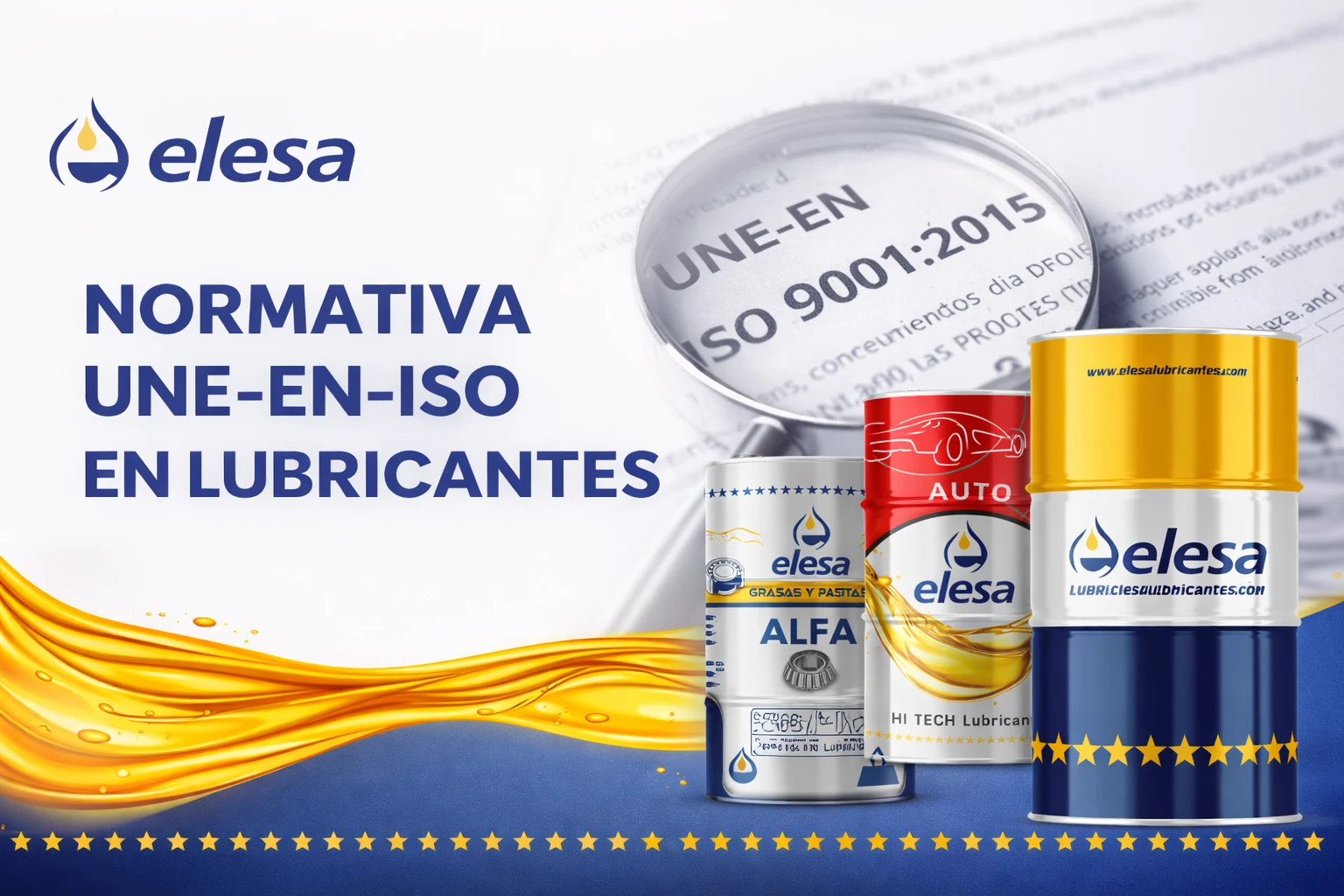
UNE-EN-ISO standards for lubricants set out the quality, safety and performance requirements that products used in industrial environments must meet. These certifications guarantee that lubricants have been developed and assessed according to internationally recognised technical criteria, which is essential to ensure the correct operation of machinery and compliance with requirements in demanding sectors. In an industrial environment where reliability and safety are priorities, working with lubricants that meet these standards helps to reduce operational risks, improve efficiency and ensure product traceability.
What do UNE, EN and ISO mean for lubricants?
The acronyms UNE, EN and ISO refer to different levels of standardisation applied to industrial products, including lubricants. UNE corresponds to the Spanish standards developed by the Asociación Española de Normalización, EN refers to European standards and ISO to globally recognised international standards.
When a lubricant complies with a UNE-EN-ISO standard, it means it has been adapted and validated under a common framework that ensures it is compatible with the technical requirements demanded in different countries and industrial sectors. This harmonisation makes it easier to standardise processes and enables companies to operate with greater confidence and consistency in international settings.
What do UNE-EN-ISO standards regulate in lubricants?
UNE-EN-ISO standards applied to lubricants cover various technical aspects relating to their formulation, physical properties and behaviour under operating conditions. These standards define parameters such as viscosity, thermal stability, oxidation resistance, wear protection and water separation capacity, among others.
They also establish standardised test methods that allow lubricant performance to be assessed objectively. This is especially important in industrial environments where product reliability is critical and where small variations in lubricant properties can affect machine performance.
Why compliance with standards matters in industrial environments
Compliance with UNE-EN-ISO standards for lubricants is a key factor in ensuring safety and efficiency in industrial operations. Using products that do not meet these standards can lead to mechanical failures, shorter equipment service life and problems in quality audits, particularly in regulated sectors such as food, pharmaceuticals or automotive.
Using certified lubricants also helps companies comply with their own quality management systems, such as ISO 9001 or ISO 14001, making traceability and process control easier. This translates into greater confidence among customers and regulatory bodies, as well as reduced operational risks.
The most relevant ISO standards in lubrication
In the field of lubricants, there are various ISO standards that apply depending on the type of product and its use. Some of the most relevant relate to viscosity classification, test methods for determining physical and chemical properties, and quality standards for industrial oils and greases.
These standards make it possible to compare products from different manufacturers against uniform criteria, making it easier to select the right lubricant for the needs of each application. They also help to define clear technical specifications in industrial purchasing and maintenance processes.
The link between standards and lubricant selection
Choosing a lubricant that complies with UNE-EN-ISO standards is not just a matter of compliance, but a strategic decision that directly affects machine performance. These standards serve as a benchmark to ensure that the product offers the properties needed to work under specific conditions, such as high loads, extreme temperatures or contaminated environments.
When selecting a lubricant, it is important to review the technical specifications and check that it complies with the standards applicable to the equipment and the sector. This helps to minimise risks, optimise maintenance and ensure reliable long-term operation.
Advantages of using certified lubricants
Using lubricants that comply with UNE-EN-ISO standards brings multiple benefits in industrial environments. These include improved equipment reliability, fewer breakdowns and optimised maintenance intervals.
These products also deliver more consistent performance, which makes it easier to standardise processes and manage maintenance. They also help to improve energy efficiency and reduce environmental impact, especially when using lubricants formulated according to sustainability criteria.
Guarantee the quality of your lubrication with certified products
Working with lubricants that comply with UNE-EN-ISO standards is a guarantee of quality, safety and performance in any industrial environment. These certifications not only ensure that the product has been developed to demanding technical standards, but also enable companies to operate with greater confidence and efficiency.
Opting for certified lubricants is a key decision to optimise maintenance, reduce risks and improve competitiveness in sectors where equipment reliability is essential.