
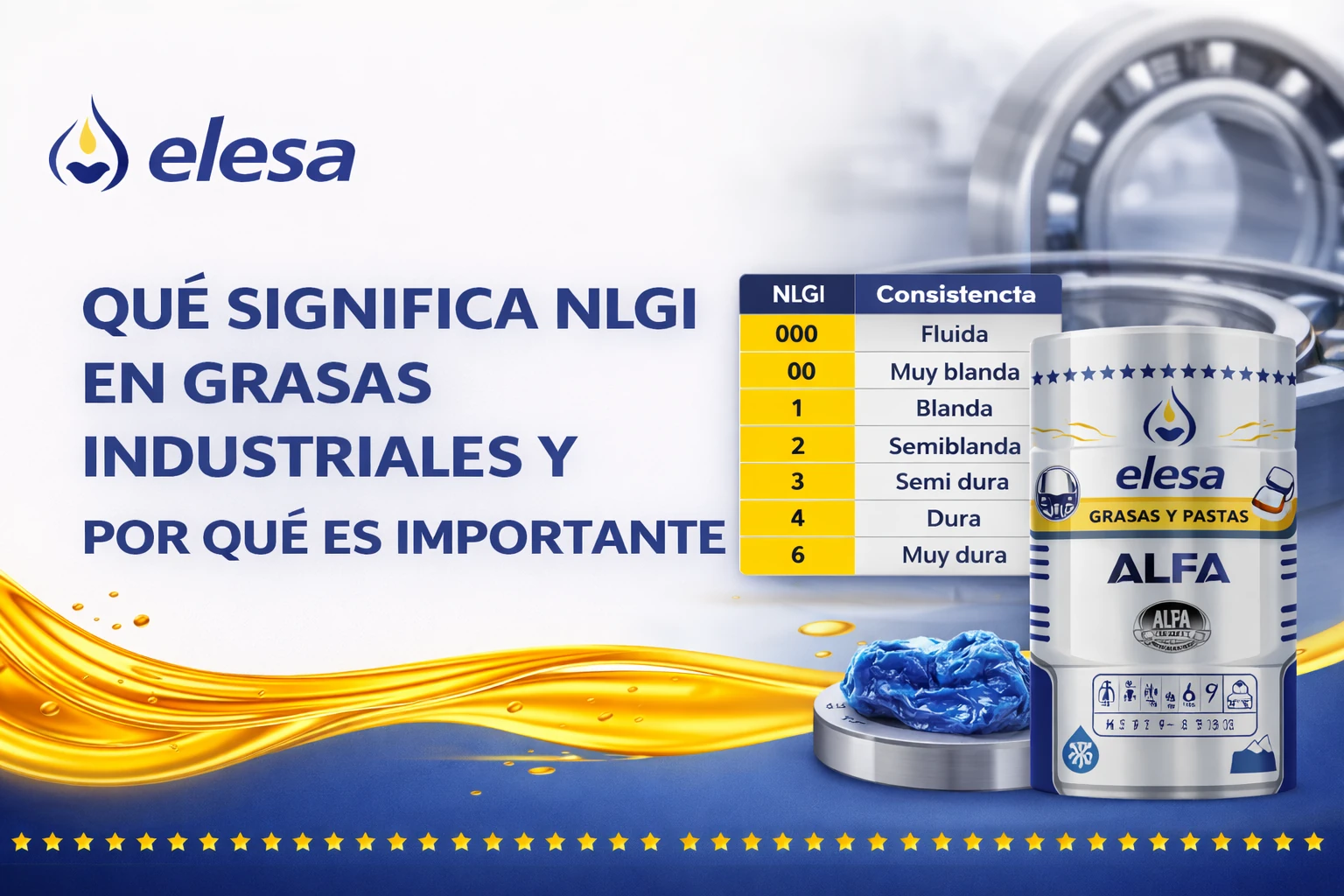
The term NLGI is fundamental in the world of industrial greases and refers to the consistency of the lubricant, that is, how hard or fluid it is. The acronym stands for the National Lubricating Grease Institute, the body that establishes a standard classification used internationally to identify the different consistencies of greases. Understanding what NLGI means is key to selecting the right lubricant for the application, since the wrong choice can lead to lubrication failures, overheating or premature component wear.
What is the NLGI classification?
The NLGI classification defines the consistency of a lubricating grease using a numerical scale that generally runs from grade 000 to grade 6, where lower values correspond to more fluid greases and higher values to stiffer greases. The classification is based on penetration tests that determine how the grease behaves under given conditions.
In practical terms, an NLGI 000 grease has an almost liquid consistency, while an NLGI 2 grease, one of the most widely used in industry, has a butter-like texture that makes it suitable for a wide range of applications. Greases with a higher NLGI grade, such as 3 or 4, are stiffer and are used in specific conditions where greater adhesion is required.
What NLGI is used for in lubricating greases
The NLGI grade is a key parameter for ensuring that the grease stays at the lubrication point and performs its function properly. If the grease is too fluid, it can escape from the application point and fail to protect the component adequately. If it is too stiff, it may not distribute properly and can create additional friction.
Choosing the right NLGI grade therefore ensures efficient lubrication, keeps the lubricant stable in the system and optimises machinery performance. This is especially important in bearings, gears and systems subject to continuous loads and movement.
Differences between the main NLGI grades
The different NLGI grades suit different industrial applications depending on the operating conditions. The most fluid greases, such as NLGI 000 or 00, are used in centralised systems or enclosed gears where the lubricant needs to flow easily.
Medium-consistency greases, such as NLGI 1 and NLGI 2, are the most common in general applications, especially in bearings and standard mechanical components. Stiffer greases, such as NLGI 3 or higher, are used where the lubricant needs to stay in place longer, such as at high temperatures or under heavy loads.
Selecting the right NLGI grade for the application is essential to avoid lubrication problems and ensure equipment durability.
How to choose the right NLGI grade
The choice of NLGI grade depends on several factors related to the application and operating conditions. The most important include equipment speed, operating temperature, load and the type of lubrication system.
High-speed applications usually call for more fluid greases that help the lubricant circulate, whereas under high-load or low-speed conditions, stiffer greases that stay at the contact point are preferred.
It is also important to consider the application method, as automatic or centralised systems generally require lower-consistency greases that can flow easily.
The importance of NLGI in industrial maintenance
The NLGI grade affects not only lubrication but also the efficiency of industrial maintenance. Using the right grease helps reduce wear, minimise breakdowns and optimise maintenance intervals.
Correct NLGI selection helps improve equipment reliability, reduce operating costs and prevent unplanned downtime. In industrial settings where operational continuity is critical, this factor becomes especially important.
Improve your equipment's lubrication with the right grease
Understanding what NLGI means and how it affects lubrication is essential to select the right product for each application. Choosing the right grease consistency ensures effective component protection, improves machinery performance and extends its service life.
Having lubricants tailored to each need is key to optimising maintenance and ensuring reliable operation in any industrial environment.