
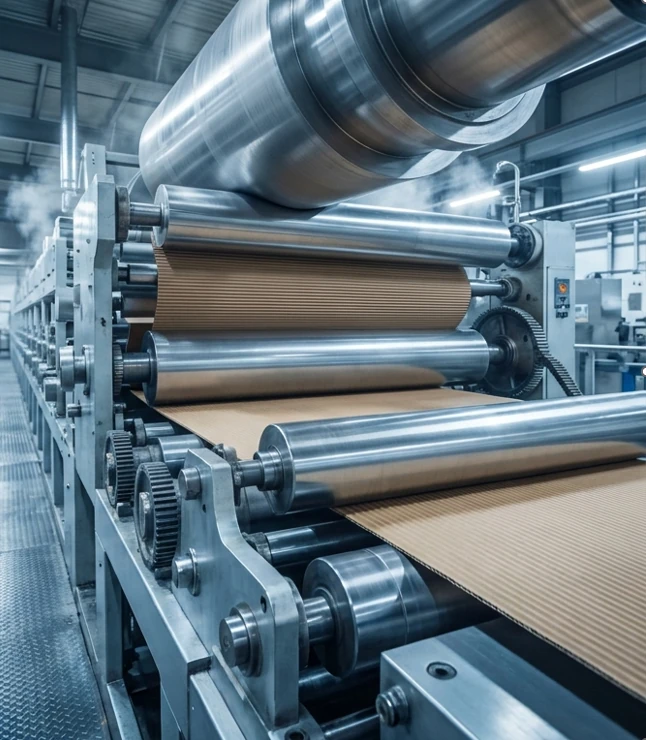
In the paper and board industry, production lines operate under particularly demanding conditions. The combination of high temperatures, humidity, steam, heavy loads and continuous operation makes lubrication a critical factor in maintaining plant availability.
In equipment such as corrugators, dryers, calenders, reducers, glazing cylinders and auxiliary systems, choosing the wrong lubricant can lead to premature wear, seizures, unplanned stoppages and a considerable increase in maintenance costs.
This case study shows how a paper and board manufacturer optimised the lubrication of its continuous corrugating and drying line with a combined technical solution using Elesa products.
The challenge: reducing incidents on a line exposed to heat, humidity and load
The customer had a continuous production line made up of corrugating equipment, dryers, a glazing cylinder and auxiliary machinery. The plant had been suffering repeated incidents at critical points of the installation, especially in corrugator bearings, dryer bearings, reducers, submerged pumps and the glazing cylinder ring gear.
The most frequent problems were related to premature wear, loss of lubricant effectiveness due to water or steam, high operating temperatures and excessively frequent regreasing. All of this affected line stability and increased the maintenance team's workload.
In addition, certain points of the installation were exposed to particularly aggressive conditions, such as contact with water, caustic soda solutions, acids or high loads caused by paper web tension. A generic lubrication solution was therefore not enough. Specific products had to be selected for each working area.
Technical analysis of the installation
After reviewing the line, four main needs were identified: ensuring reliable lubrication in high-temperature areas, protecting mechanisms against water and process chemicals, improving performance at points subject to high loads, and reducing both lubricant consumption and maintenance times.
The diagnosis made it possible to clearly distinguish the needs of each application. The corrugating rolls and calenders required products capable of maintaining their thermal stability. The dryers needed oils suitable for bearings operating at moderate or high temperatures. The submerged pumps and areas exposed to caustic soda called for a washout-resistant grease, while the glazing cylinder ring gear, open gears and chains required adhesive, protective lubrication.
The Elesa solution
Based on the technical analysis, a combined solution was implemented using industrial oils and greases from the Elesa portfolio recommended for the paper and board industry.
For the corrugating units and the lubrication of corrugating roll bearings, elesa® ACEITE AIR 100 PREMIUM PAO was used, suitable for applications requiring stability and continuous performance.
For the dryer bank bearings, two solutions were applied depending on the operating temperature: elesa® ACEITE GEAR IND 220 EP PLUS MOS2 for moderate temperatures and elesa® ACEITE GEAR IND 220 SINT MOS2 for points exposed to high temperatures.
For the cylinder bearings of the board corrugators, where temperature was one of the critical factors, elesa® GRASA FLUORLUBE was introduced. For mechanisms subjected to very high paper tension loads, elesa® GRASA MOLYT 034 was selected, while elesa® GRASA MOLYT 064 was used in mechanisms in contact with water and caustic soda solutions, including submerged pumps.
Finally, for open gears, slideways and chains in contact with water and acids, including the glazing cylinder ring gear, elesa® GRASA CAPLEX 038 FILM was applied to provide an adhesive lubricating film that stands up to aggressive conditions.
Implementation in the plant
The implementation was carried out gradually to ensure production continuity. First, the lubrication points were reviewed and classified by temperature, load, presence of water, component type and intervention frequency. The previous lubricants were then replaced with products better suited to each application.
One of the key points of the project was standardisation. The plant went from working with scattered solutions to using a more coherent range of lubricants tailored to its actual needs. This made the maintenance team's work easier, simplified product control and allowed relubrication intervals to be better adjusted.
Results achieved
After standardising lubrication, the plant achieved a clear improvement in line reliability. Bearing failures in the corrugating and drying sections were reduced, greater stability was achieved at high-temperature points, and stoppages associated with seizure and wear decreased.
The improvement was also reflected in relubrication intervals. By using products better suited to each application, it was possible to cut unnecessary interventions, reduce lubricant consumption and spend less time on corrective tasks.
Overall, the customer gained a more stable line, more consistent lubrication and better protection in humid, aggressive and high-load environments.
Benefits for the customer
The main benefit was increased line availability. With fewer incidents at critical points, the plant was able to operate more continuously and with less reliance on corrective interventions.
Better protection was also achieved in environments with humidity, steam, water, caustic soda and acids, along with reduced wear in mechanisms subject to high loads. Standardising products also helped simplify maintenance and reduce the total cost associated with lubrication, breakdowns and stoppages.
Conclusion
This case shows that lubrication in the paper and board industry must be adapted to the actual conditions at each working point. A single line can combine high-temperature applications, wet areas, open gears, submerged pumps, chains and mechanisms subject to high loads.
Implementing a technical solution with Elesa products improved the reliability of the installation, reduced incidents and optimised maintenance tasks. Choosing the right lubricant not only protects machinery but also contributes directly to improving productivity and reducing the total cost of operation.
Do you want to optimise lubrication in your paper and board plant?
At Elesa Lubricantes, we analyse the critical lubrication points of your installation and help you select the most suitable industrial oil or grease for each application.
Request technical advice and improve the reliability of your production line.